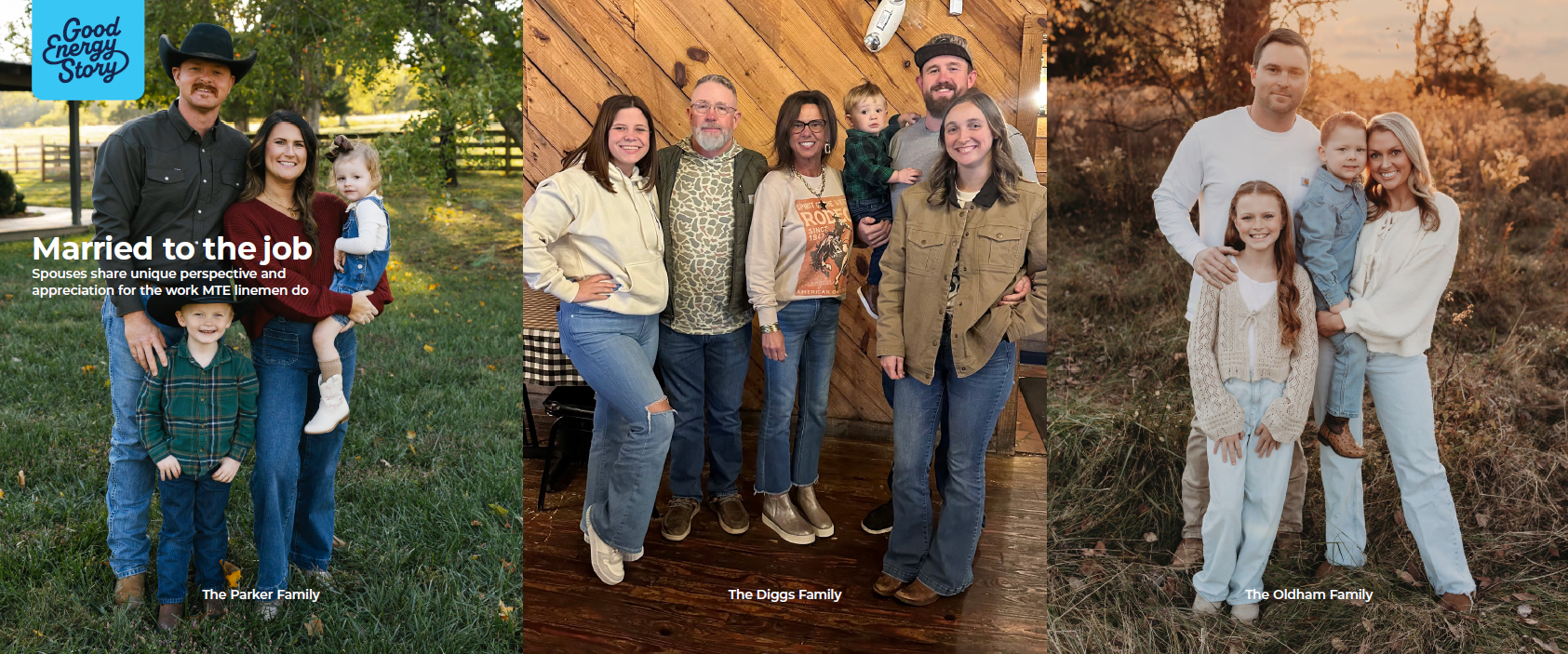
Married to the job
Spouses share unique perspective and appreciation for the work MTE linemen do
Emilie Oldham doesn’t bother to count the number of milestone moments her husband has missed. Kayla Parker has grown content with being a party of one at many social gatherings. Even after 27 years, LaCosta Diggs still feels a pang of concern when her husband heads out the door to respond to a call for help. But not one of these women would trade her life as an MTE lineman’s wife.
These spouses are the essential behind-the-scenes support for the frontline team of lineworkers who make their living wrangling high-voltage electricity. They manage households and families alone during storm restoration callouts, along with navigating the everyday anxiety and uncertainties that come with the territory.
“We don’t give them enough credit for how important their role is in helping us do our jobs. I couldn’t do it without her,” veteran lineman Mike Diggs says, referring to his wife of 32 years.
Life on call
“It doesn’t matter what time of the day or night — whether it’s freezing cold or lightning and raining — when the power goes out, he’s getting in his truck and going to help. And he’s going to stay until the job is done,” Kayla says about husband Dylan, who became a lineman about the time they wed eight years ago. Since then, they have literally weathered many storms together.
Dylan was among the MTE linemen called into action in January when Winter Storm Fern left thousands of MTE members in the dark. “He left at 5 a.m. and didn’t come home until 10 that night,” Kayla said, echoing similar stories told by other linemen’s spouses.
Though her husband, Coty, has been an MTE lineworker for 12 years, a forecast storm still makes Emilie anxious. “While many families prepare to stay home together, we prepare for him to be gone,” she said. “Our family’s experience during storms looks very different from most, but it has also taught us resilience, patience and a deep appreciation for all first responders and their families.”
Flexible families
Uncertainty is a part of everyday life with a lineman, the women say. That’s why the “two-car rule” is common in their households. “When Coty is on call, we drive separately to church or family events so he can take his work truck and leave immediately if needed,” Emilie said. “It’s an adjustment our family has learned to accept, knowing that his work requires flexibility and readiness at all times.”
Dylan Parker’s chaotic work schedule means Kayla frequently goes solo for social functions.
“It’s more shocking that he is there than he’s not,” she said. “Family holiday gatherings, birthday parties, school functions — he misses a lot. So, I’ve had to get used to doing things by myself.”
Missing family events, especially at holiday time, is one of the greatest sacrifices, the women agree. LaCosta remembers a Christmas when Mike drove hours from a storm restoration deployment just to spend a few precious minutes with their 2-year-old son. “Then, he turned around and went right back because there were families depending on him to help get their power back on,” she said.
Holding down the home front
When her husband is working a mass outage event, Kayla manages their home and farm alone. That’s included handling frozen water pipes and caring for sick livestock. “I take care of things here to make sure he’s not worried out there. He needs to stay focused on his job to stay safe,” she said.
For a pregnant LaCosta Diggs, being a self-reliant lineman’s wife meant driving herself to the hospital when she began having contractions. Her husband was helping repair the electric grid after a tornado. “Even the hospital didn’t have power; they were running on emergency generators,” she said. “Right then, where he was needed most was helping to restore power for everybody.”
Wives are especially challenged when their linemen-husbands are called away for days or weeks to assist other utilities
with post-storm repairs. “During those periods, I continue working full time while caring for our kids on my own. You do what you have to do,” Emilie said. “We miss him, but we also understand the importance of the work he’s doing.”
A passion for service
Despite the hardships, the women are united in supporting their husbands’ work to help others. “Dylan takes a lot of pride in what he does, and my whole family does too,” Kayla said.
Emilie adds, “I truly never hear Coty complain or dread going to work … Seeing how much he enjoys his work is inspiring to me and our family.”
LaCosta has never regretted her husband’s choice to serve the community.
“I knew the job was dangerous and would take him away from home sometimes, but line work is his passion. I encouraged his dream then and still do.”
More from MTE
An updated from United Communications
SharingChange Spotlight: Break-Thru Tennessee